

Introduction
Some people assume a trucking career requires years of experience before anyone will hire them. That assumption is wrong. Getting a CDL with no experience is not only possible but also exactly how the industry expects most new drivers to start.
The trucking industry is facing one of the largest driver shortages in its history, and carriers are actively recruiting people with no commercial driving experience.
Is It Hard to Get a CDL with No Experience?
No. Getting a CDL with no experience is achievable for most people. The process assumes you are starting from scratch.
Every current CDL holder started with no commercial driving experience. The industry has built training pathways specifically for people in that position. Full-time students can complete training and be road-ready in as few as four to six weeks.
Who Can Get a CDL?
Before starting the process, candidates should confirm they meet the basic federal requirements:
- Age: at least 18 years old to drive intrastate (within your state); at least 21 to drive interstate (across state lines) or haul hazardous materials
- Valid regular driver’s license with no disqualifying violations
- Ability to pass a DOT medical examination
- No disqualifying criminal history (standards vary by state and employer)
Most CDL schools review these requirements during the enrollment process and can help candidates understand whether anything in their background might affect their options.
Why the Trucking Industry Needs New Drivers
The trucking sector has a workforce gap that keeps growing. The Bureau of Labor Statistics projects the industry will need 89,000 new driving jobs by 2034. Older drivers are retiring faster than new ones are entering the field, creating openings across local, regional, and long-haul routes.
Carriers actively recruit drivers fresh out of CDL school. Many have structured programs designed to help entry-level drivers gain experience and earn good pay from the start. The driver shortage has lowered barriers that once made it harder to break in.
What “Entry-Level Driver Training” Means in Trucking
In trucking, entry-level means a driver who holds a CDL but has not yet driven a commercial motor vehicle professionally. Federal regulations require that entry-level driver training (ELDT) be completed before taking the CDL skills test. This applies to:
- Drivers getting a Class A or Class B CDL for the first time
- Drivers upgrading from Class B to Class A
- Anyone adding passenger, school bus, or hazardous materials (HazMat) endorsements
This means training must be completed through a provider listed in the Federal Motor Carrier Safety Administration’s Training Provider Registry.
How to Get a CDL with No Prior Experience
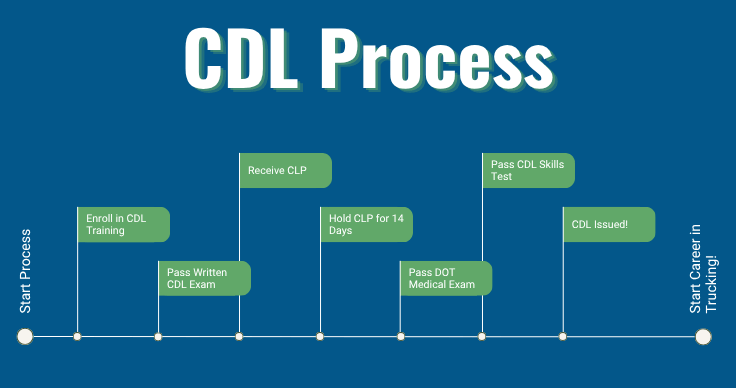
The path to a CDL follows a set federal process. Most CDL schools will help you through these steps start to finish, so you don’t have to do these steps on your own. Here is what the process looks like:
Step 1: Enroll in CDL Training
Finding your ELDT-compliant training program comes first. Admissions representatives will help you:
- Confirm the training is ELDT compliant
- Determine how you can pay for your training
- Find a program start date
- Ensure you meet eligibility requirements for both federal and state requirements.
Step 2: Pass the written CDL exam and get your CLP
After completing the classroom portion of CDL training, candidates take the written CDL exam. Passing earns a Commercial Learner’s Permit (CLP). The CLP allows practice driving with a licensed CDL holder in the vehicle. Candidates must hold their CLP for at least 14 days before scheduling the skills test.
Step 3: Get your DOT medical certification
Candidates must pass a Department of Transportation (DOT) physical with an examiner listed in the National Registry of Certified Medical Examiners. This exam confirms that the driver meets the physical fitness standards required for commercial driving.
Step 4: Pass the CDL skills test
The CDL skills test has three parts:
- Pre-trip vehicle inspection — candidates identify vehicle components and explain their function
- Basic vehicle control — demonstrates backing and maneuvering skills
- Road test — evaluates driving in real traffic conditions
How to Land Your First Trucking Job as a New CDL Driver
New CDL holders sometimes face resistance from carriers. Many trucking companies hesitate to hire inexperienced drivers because of higher insurance costs and a greater statistical chance of accidents. Some insurers won’t cover drivers with less than a certain level of experience.
That said, many carriers do hire new graduates. The key is knowing how to position yourself and where to apply.
Speak with your School’s Job Placement Reps
Job placement support at your CDL school really begins when you first enroll. Most schools have relationships with employers, and representatives visit the campus regularly. Know when recruiters are visiting and make time to speak with them.
Many students land jobs before their training program is even complete. By participating in recruiter events, you have a better chance of getting hired quickly.
What Hiring Managers Look for in New Drivers
Before applying anywhere, check that the company hires new CDL graduates. Look for phrases like “no experience needed” or listings that mention apprentice or training programs.
Beyond the CDL itself, carriers evaluate:
- Clean criminal background and driving record
- Attitude and willingness to learn
- Relevant work history (warehouses, equipment operation, livestock handling)
Understanding Pay Structures
Pay varies a lot across carriers, and it is worth understanding the models before comparing offers. Common structures include:
- Pay per mile: earnings increase with distance driven; common for over-the-road positions
- Salary: consistent pay regardless of mileage; more common for local and regional roles
- Hourly: time-based pay, typically for local delivery and specialized work
Benefits packages can significantly affect the total value of a job offer, especially for drivers with families. Health insurance, retirement contributions, and home-time policies are all worth comparing alongside base pay.
How to Make your Application Stand Out
New drivers can strengthen their applications by:
- Highlighting relevant work experience that shows mechanical awareness or attention to safety
- Having all documents ready before applying (CDL, medical certificate, MVR, employment history)
How to Prepare for Your First Trucking Interview
Be ready to talk about additional on-the-job training. Carriers want drivers who are eager to continue learning after leaving CDL school. Showing that attitude in the interview sets new drivers apart.
What to Do if You Get Rejected
Rejection is normal. Most new CDL graduates apply to 10–15 companies before landing the right role. You can always speak to your school’s job placement department for advice on how to make yourself more attractive to employers.
Tips to Get Hired Faster as a Brand-New CDL Driver
Keep your Driving Record Clean
A clean Motor Vehicle Record (MVR) is one of the most powerful tools a new driver has. Carriers check MVRs to assess insurance risk. Drivers with no violations or accidents are cheaper to insure and more attractive to hire. Even minor infractions can reduce hiring chances when companies compare recent graduates.
Be Professional and Responsive with Recruiters
Recruiters pay attention to how quickly and professionally candidates respond. Ghosting a recruiter is likely to result in being passed over. Candidates who answer calls quickly, reply to messages promptly, and submit documents without delay consistently secure positions faster.
Text messages tend to work better than email for recruiter communication. Respond within 48–72 hours of any contact.
Find Other Driving Jobs
Many people who want over-the-road trucking roles build experience by driving delivery trucks, dump trucks, or other vehicles. Remember, when you’re building experience as a driver, any jobs you can work count as experience.
Consider Team Driving or Mentorship Programs as a First Step
Structured training programs are a strong option for new graduates who want to build experience fast while earning income. After six to twelve months with a program like this, drivers typically have access to better routes, higher pay, and more job options.
Conclusion
Getting a CDL with no experience is not just achievable — it is the industry standard starting point. Carriers know that every driver on the road was once where you are now, and the shortage of new drivers means they are motivated to help you succeed. The path is clear, the demand is real, and the timeline is shorter than most people expect.
A trucking career offers steady income, long-term job security, and a level of independence that is hard to find in most fields. TransTech provides the training, placement support, and industry connections to help new drivers make it from the classroom to the cab — and build a career that lasts.
Frequently Asked Questions
Do I need any experience with large vehicles before starting CDL training?
No prior experience with trucks or commercial vehicles is required to enroll in CDL training. Programs are built for people starting from scratch. Some students come in having driven nothing larger than a pickup truck. Instructors teach vehicle operation from the ground up, so prior experience is helpful but not a requirement.
What happens if I fail the CDL skills test?
Failing the CDL skills test is not the end of the road. Most states allow candidates to retake the test after a waiting period, though rules vary by state. Candidates typically retake only the portion they failed, not the entire exam. Check with your state DMV and your training provider to understand the next steps after a failed attempt.
What types of companies hire drivers with no experience?
Several types of carriers hire new CDL holders, including:
- Mega carriers like Schneider and Stevens Transport
- LTL (less-than-truckload) freight companies
- Construction material haulers
- Fuel delivery services
- Food and beverage distributors
Many of these companies offer company-sponsored training programs, mentorship opportunities, or team driving positions built specifically for entry-level drivers.
Should I consider a mega carrier as my first employer?
Working for a mega carrier for six months to a year is a common path for new drivers. These positions provide valuable road time and open doors to better opportunities. After gaining experience, drivers typically have access to more local routes, better pay, and improved working conditions at other companies.
Do I need special endorsements to get hired as a new CDL driver?
A basic Class A CDL may be enough for some entry-level positions, but adding endorsements like Hazmat or Tanker can increase job options and earning potential and make you more attractive to employers. Consider adding endorsements to increase your chances of being hired.
