
How to Get a CDL: Getting Started
Table of Contents
- What Is a CDL and Do You Need One?
- Step 1: Choose Your CDL Class
- Step 2: Meet the Basic Eligibility Requirements
- Step 3: Pass Your CDL Knowledge Test and Get Your CLP
- Step 4: Pass Your DOT Physical
- Step 5: Complete ELDT Training
- Step 6: Pass Your CDL Skills Test
- Step 7: Receive Your CDL and Start Your Career
- Frequently Asked Questions
What is a CDL and Do You Need One?
A Commercial Driver’s License (CDL) is a specialized driver’s license required to operate large commercial vehicles — think tractor-trailers, dump trucks, large buses, and vehicles carrying hazardous materials. If you’re looking to drive professionally and get paid to be behind the wheel of one of these vehicles, a CDL is your starting point.
You need a CDL if you plan to operate any of the following:
- A combination of vehicles with a combined weight of 26,001 lbs or more
- A single vehicle with a gross vehicle weight rating (GVWR) of 26,001 lbs or more
- Any vehicle designed to transport 16 or more passengers (including the driver)
- Any vehicle transporting hazardous materials that require placards
The good news: getting a CDL is a straightforward, step-by-step process. Most people with no prior commercial driving experience go from zero to licensed in about four to six weeks. Here’s exactly how it works.
Step 1: Choose Your CDL Class
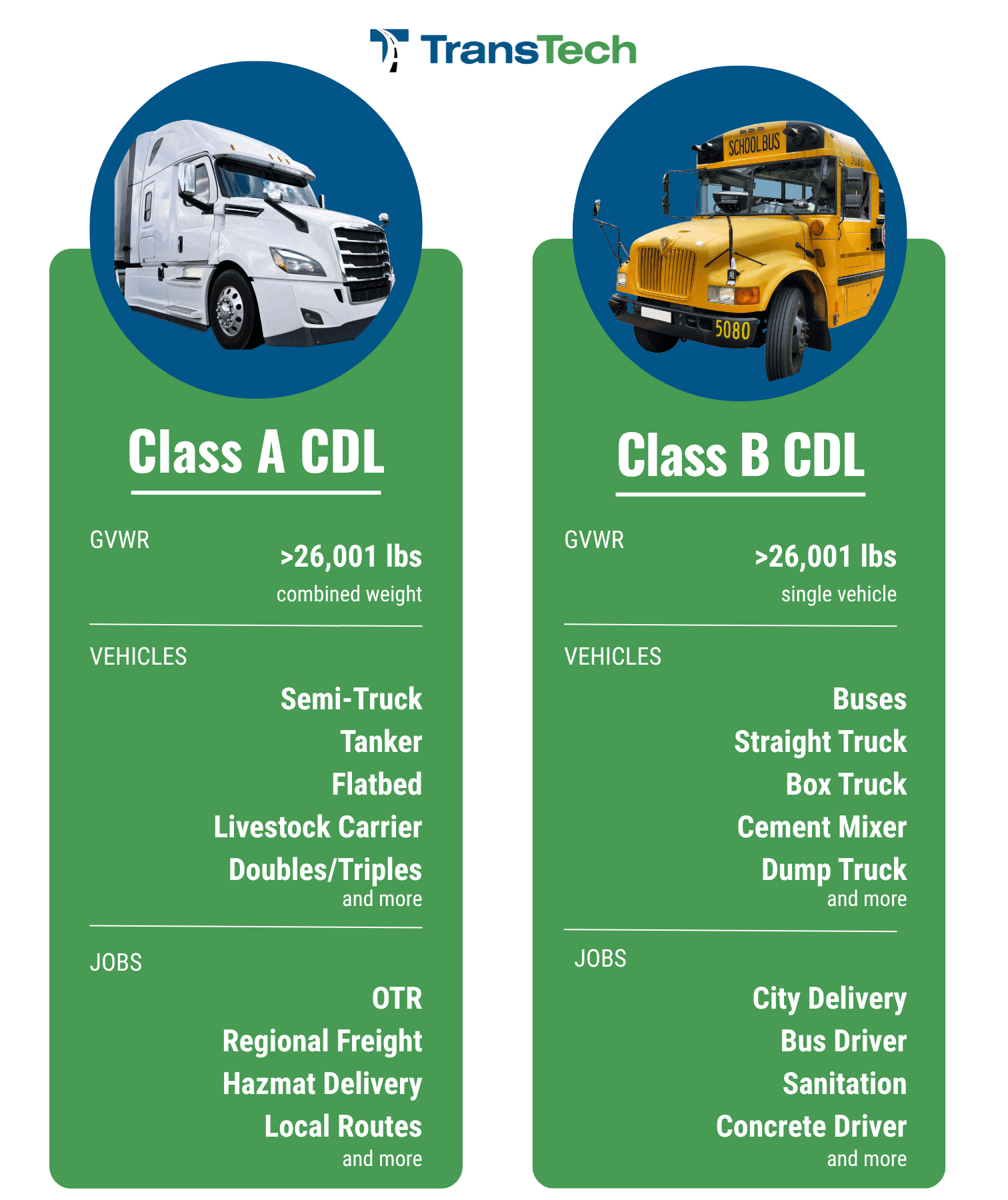
Before anything else, you need to know which type of CDL you’re going after. There are three classes, but for most people entering the trucking industry, the choice comes down to two:
Class A CDL The most versatile license in trucking. A Class A covers combination vehicles — a powered unit (like a semi-truck) connected to a trailer — where the total combination weighs 26,001 lbs or more and the trailer itself weighs more than 10,000 lbs. If you want to drive tractor-trailers, flatbeds, or tankers on long-haul or regional routes, Class A is what you need. A Class A also permits you to drive Class B and C vehicles with the right endorsements.
Class B CDL A Class B covers large single vehicles — straight trucks, dump trucks, large delivery vehicles, and buses — with a GVWR of 26,001 lbs or more, as long as any trailer being towed doesn’t exceed 10,000 lbs. If your goal is local delivery, waste management, transit, or school bus driving, Class B is often the right fit.
Class C CDL Class C covers smaller commercial vehicles not classified as A or B — typically vehicles designed to carry 16 or more passengers or those hauling certain hazardous materials. This class is less common for first-time CDL seekers.
Not sure which class fits your goals? Compare Class A and Class B CDL programs at TransTech →
Step 2: Meet the Basic Eligibility Requirements
No matter which state you’re in, every CDL applicant must meet a core set of federal eligibility requirements before the process can begin:
- Age: You must be at least 18 years old. Drivers under 21 are generally restricted to driving within their home state (intrastate) only. Interstate driving — crossing state lines — requires you to be at least 21.
- Valid driver’s license: You must hold a current, non-suspended regular driver’s license in your state of residence.
- Clean enough record: Your driving history will be checked. Certain disqualifying offenses — DUIs, reckless driving, and others — can delay or prevent CDL issuance. Check with your state’s motor vehicle agency if you have concerns.
- English proficiency: Federal regulations require CDL holders to be able to read and speak English well enough to understand road signs, communicate with law enforcement, and complete required paperwork.
- Residency: You must apply for a CDL in the state where you legally reside. You can only hold one CDL at a time, and it must be issued by your home state.
While these federal requirements apply everywhere, every state adds its own layer – specific fees, testing procedures, permit rules, renewal schedules, and agency-specific requirements that vary from state to state. If you’re getting your CDL in Georgia, North Carolina, or South Carolina, the pages below cover every state-specific detail you need to know before you walk through the door.
Select your state for complete CDL requirements:
Step 3: Pass Your CDL Knowledge Test and Get Your CLP
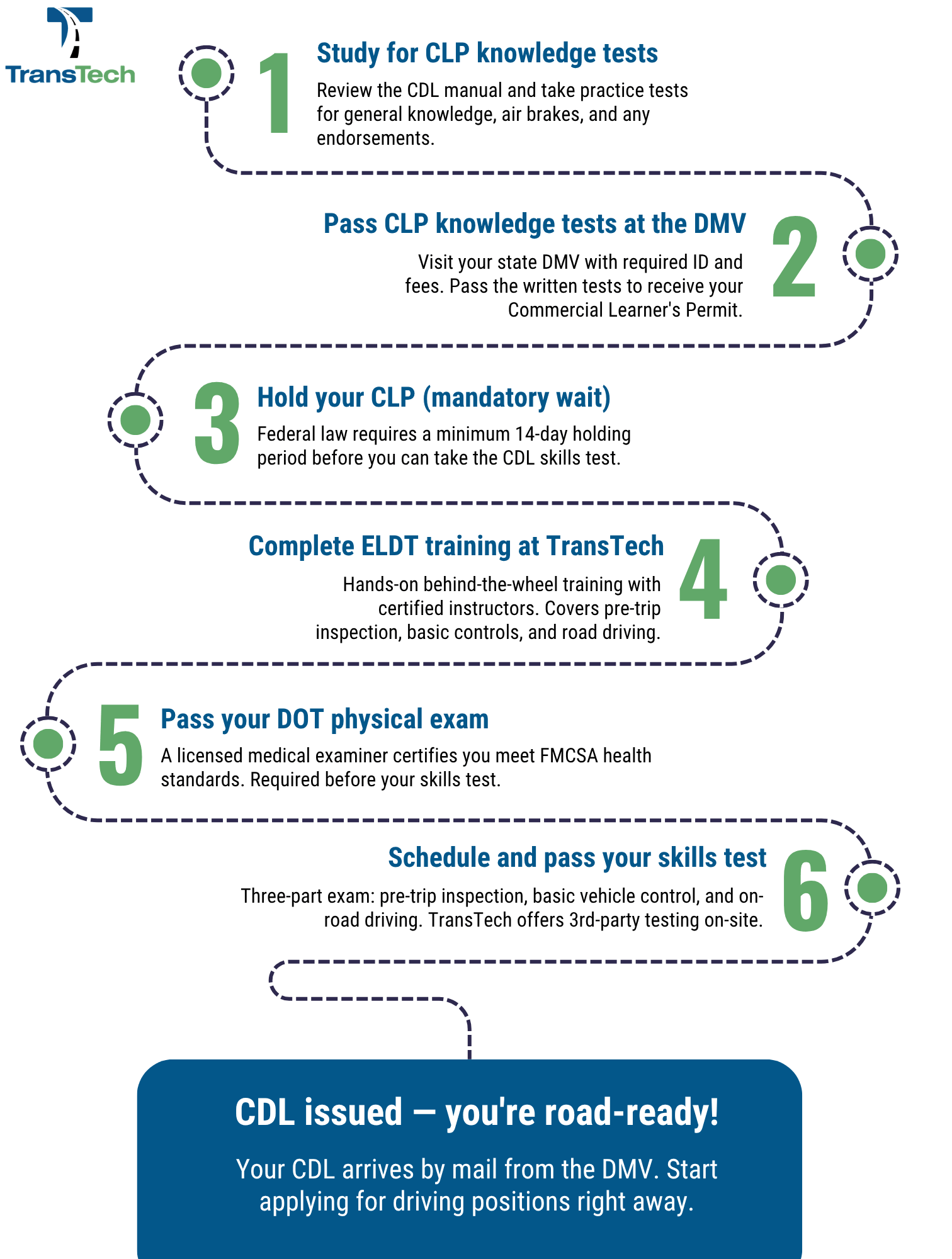
Your first official step at the DMV (or your state’s equivalent motor vehicle agency) is earning a Commercial Learner’s Permit (CLP). Think of the CLP as your learner’s permit for commercial vehicles — it gives you legal permission to practice driving a CMV under the supervision of a licensed CDL holder while you complete your training.
To get your CLP, you’ll need to:
- Study your state’s Commercial Driver’s License Manual — it covers everything from vehicle inspection to federal safety regulations
- Visit your state motor vehicle office with the required identity documents
- Pass a vision test
- Pass the CDL General Knowledge written test (and any class- or endorsement-specific tests)
- Pay the applicable state fees
- Receive your CLP
Once your CLP is in hand, federal law requires you to hold it for a minimum of 14 days before you can take the CDL skills test. Use that time wisely — this is when your hands-on training begins.
Important: While holding your CLP, you may only operate a commercial motor vehicle under the direct supervision of a licensed CDL holder of the same class or higher, seated in the front passenger seat at all times.
At TransTech, a CLP is not required to enroll because students will earn it during the first week of training.
Step 4: Pass Your DOT Physical
A valid Department of Transportation (DOT) physical exam is required before you can begin ELDT training and operate a commercial motor vehicle. This is a medical evaluation performed by a certified examiner on the FMCSA’s National Registry of Certified Medical Examiners — not just any doctor will do.
The exam evaluates your overall fitness to safely operate a large commercial vehicle, including:
- Vision — minimum 20/40 acuity in each eye, with or without correction
- Hearing — ability to hear a forced whispered voice from five feet
- Cardiovascular health — blood pressure, heart function
- Neurological function — no conditions that could impair safe driving
- Urinalysis — screening for underlying health conditions
Most CDL programs also require a pre-enrollment drug screening before you set foot in the truck. This is a federal requirement tied to FMCSA’s drug and alcohol regulations for commercial drivers.
If you pass both the physical and drug screen, you’ll receive a Medical Examiner’s Certificate, which is valid for up to 24 months. This certificate must be kept current throughout your career — if it lapses, your CDL driving privileges can be affected.
At TransTech, we handle your DOT physical during training, so there’s nothing to schedule before you enroll.
Step 5: Complete ELDT Training
Since February 2022, all first-time CDL applicants in the United States are required by federal law to complete Entry-Level Driver Training (ELDT) before they can take the CDL skills test. This isn’t just a formality — it’s a structured training program that prepares you to actually operate a commercial vehicle safely.
ELDT must be completed through a school that is listed on the FMCSA’s Training Provider Registry (TPR). This is an important detail: if your school is not on the registry, your training will not count toward your CDL, regardless of how many hours you put in. Always verify your school’s TPR listing at tpr.fmcsa.dot.gov before enrolling.
ELDT training covers:
- Basic vehicle control — accelerating, braking, steering, and shifting
- Backing maneuvers — straight-line, offset, and alley dock
- Pre-trip vehicle inspection — identifying defects before you drive
- On-road driving — navigating traffic, intersections, highways, and turns
- Safety regulations — Hours of Service, weight limits, and federal compliance
At TransTech, our full-time ELDT programs are completed in four weeks. Part-time weekend options are available and typically take eight weekends. All TransTech programs are registered on the FMCSA Training Provider Registry.
Learn more about ELDT training at TransTech →
What Students Learn at TransTech →
Step 6: Pass Your CDL Skills Test
The CDL skills test is the final gate between you and your license. After holding your CLP for at least 14 days and completing your ELDT training, you’ll schedule your skills test through your state motor vehicle agency or an approved third-party testing provider.
The skills test has three parts, always completed in this order:
- Pre-Trip Vehicle Inspection — you’ll walk around the vehicle and demonstrate that you can identify anything that would make the truck unsafe to drive. This is pass/fail and must be completed before the rest of the test proceeds.
- Basic Vehicle Control — you’ll perform a series of backing and maneuvering exercises in a closed course setting. Straight-line backing, offset backing, and alley docking are standard components.
- On-Road Driving — you’ll take the vehicle out on public roads and demonstrate your ability to handle real traffic conditions, including intersections, lane changes, curves, railroad crossings, and highway driving.
You must bring a commercial motor vehicle to the test that matches the class of CDL you are applying for. At TransTech campuses that offer on-site third-party testing, a vehicle is provided as part of the program.
Learn More About CDL Testing →
Step 7: Receive Your CDL and Start Your Career
Pass your skills test and you’re done. Depending on your state, your CDL may be issued the same day or mailed to you within a few weeks. Either way, you’ll receive documentation confirming your license so you can begin working right away.
From there, the road is open. The trucking industry is one of the most in-demand career fields in the country, with competitive starting pay, strong job placement rates, and opportunities across local, regional, and over-the-road routes. TransTech’s job placement support connects graduates with hiring carriers across the Southeast and beyond.
Explore job placement support at TransTech →
Frequently Asked Questions: How to Get a CDL
How long does it take to get a CDL?
Most people complete the entire CDL process — from studying for the knowledge test to passing the skills test — in four to six weeks. At TransTech, full-time students finish their ELDT training in four weeks. Because the 14-day CLP holding period and your training can overlap, there’s no need to wait around between steps.
Do I need prior experience to get a CDL?
No. CDL training programs are designed for people with no commercial driving background. You’ll start with the basics and build up to full road competency before your skills test. Previous experience with large vehicles can be helpful but is not required.
How much does it cost to get a CDL?
Total costs vary by state and school. State fees typically range from $75 to $200 for the licensing process itself. CDL school tuition varies by program — contact a TransTech campus near you for current pricing and available financial assistance options.
What’s the difference between a CDL and a regular driver’s license?
A regular driver’s license covers personal vehicles and light-duty trucks. A CDL is required to operate commercial motor vehicles above certain weight thresholds, passenger capacity limits, or cargo types. The testing process is more involved, but the skills you gain open the door to a professional driving career.
Can I get a CDL if I wear glasses or hearing aids?
Yes. The DOT physical requires minimum vision and hearing standards, but they can be met with corrective lenses or hearing aids. Your medical examiner will evaluate your specific situation during the exam.
What is the FMCSA Training Provider Registry?
The Training Provider Registry (TPR) is a federal database maintained by the Federal Motor Carrier Safety Administration that lists all CDL schools approved to provide ELDT training. Only schools on the TPR can certify that a student has met federal training requirements. You can search the registry at tpr.fmcsa.dot.gov. All TransTech campuses are registered on the TPR.
Can I get a CDL if I’ve had a DUI?
It depends on the offense and how much time has passed. Certain major violations — including DUI convictions — can result in CDL disqualification for one year on a first offense and lifetime disqualification on a second. The rules apply whether the violation occurred in a personal or commercial vehicle. Contact your state motor vehicle agency to review your specific driving record before enrolling.
Do I have to go to CDL school, or can I self-study?
Since 2022, federal ELDT requirements make it mandatory to complete training through a registered school before taking the CDL skills test. You can still self-study for the knowledge test and CLP on your own, but the hands-on training component must be completed at a TPR-registered school like TransTech.
Your CDL Is 4 Weeks Away.
A CDL is one of the most valuable credentials in the workforce — and one of the fastest to earn. Whether you’re in North Carolina, South Carolina, or Georgia, TransTech has a campus near you with the training, instructors, and support to get you road-ready in four weeks.
CDL requirements are governed by both federal law and individual state regulations. The information on this page reflects federal FMCSA standards applicable across all states. For state-specific requirements, fees, and procedures, select your state above.