

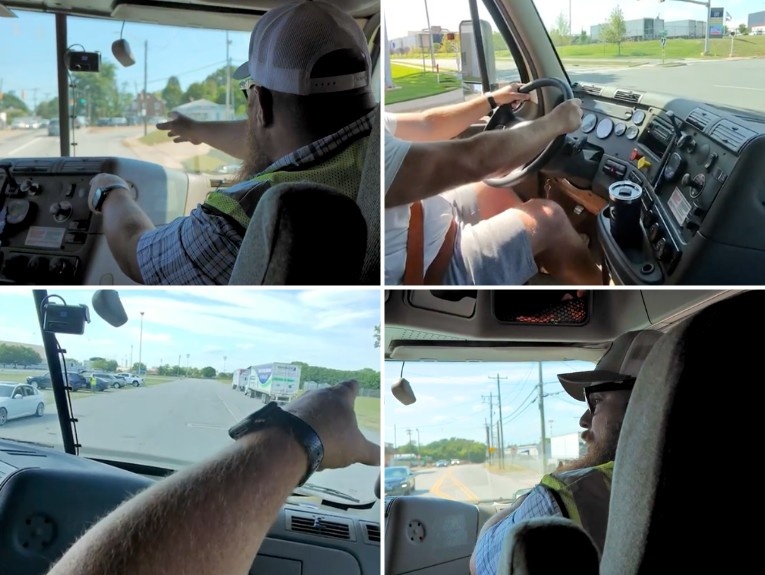
Once a student driver finishes yard training, the next step can’t be practiced in a lot. The student has to get out on the road, in real traffic, next to drivers who have no idea a student is behind the wheel. This is on-road training. It’s where everything learned in the yard gets tested in conditions nobody can fully control.
On-road training is also called road training or behind-the-wheel training. It’s a key stage of CDL school, no matter which campus a student attends. It’s also one of the most demanding stages, for both the student and the instructor riding along. Here’s what it involves and why it matters.
From Controlled Space to Open Road
In the yard, a student learns how the truck moves. On the road, they learn how the truck moves in relation to everything else. That includes other vehicles, traffic signals, lane changes, curves, and situations no amount of yard practice can fully prepare them for.
A typical road training session covers a wide range of driving scenarios, including:
- Exiting and entering traffic: judging gaps and clearing obstructions safely while getting a heavy truck up to speed or slowed down in time
- Turn signal timing and lane discipline: holding a signal until the truck is fully settled in the new lane, not cutting it off halfway through
- Braking with a loaded trailer: understanding how weight, especially liquid loads, shifts and pushes against the truck when it slows down
- Tight turns: hugging a lane line and swinging wide enough to clear a curb without cutting it
- Mirror awareness: watching the trailer’s position throughout a maneuver, not just at the start
Every one of these skills builds on habits formed during yard training. The difference now is live traffic, active intersections, and no do-overs.
Learning to Anticipate, Not Just React
One of the biggest shifts in road training is learning to think ahead. In the yard, a student mostly reacts to what the truck is doing. On the road, they have to think ahead about what everything around them might do next.
Instructors spend a lot of time reinforcing this. Keep a wide field of vision. Watch the mirrors constantly. Think several moves ahead instead of just responding to what’s directly in front of the truck. A driver who is only reacting is already behind. A driver who is anticipating has time to adjust safely.
This applies to the trailer too. A sharp turn that feels fine from the driver’s seat can make the trailer swing in a way the student doesn’t expect. That’s because the trailer can’t follow the tractor’s movement right away. Learning to feel that lag, and adjust for it before it becomes a problem, is a normal part of the learning curve. It happens to nearly every student. And it’s exactly why an instructor is there.
Why Instructors Ride Along for Every Mile
Road training only works because an experienced instructor sits right there, talking a student through each decision as it happens. That means catching small issues before they add up. An instructor might remind a student to ease off the brakes with a heavy load, call out an upcoming turn early enough to prepare for it, or explain why the trailer swung the way it did after a hard turn.
This kind of coaching can’t come from a manual or a classroom. It comes from being in the cab, mile after mile, across different types of traffic and road conditions, until the right responses start to feel automatic instead of forced.
Exposure matters too. Students get practice in highway traffic, local traffic, and everything in between. A driver who has only trained in one type of environment isn’t fully prepared for the job. The goal is comfort and skill across the full range of conditions a driver will actually face.
Building Confidence Behind the Wheel
By the end of road training, students aren’t just familiar with the truck, they’re comfortable making decisions with it under pressure, with real consequences attached. That shift, from handling the truck to driving it with confidence, is the whole point of on-road training.
It’s also where many students start to feel like the job is within reach. Handling traffic, managing turns, and staying safe with tens of thousands of pounds behind them builds a different kind of confidence than practicing in an empty lot. It’s the difference between knowing how a truck works and trusting that you can handle it on the road.
Every Campus, Same Standard
The roads look different depending on where a student trains. Traffic patterns, intersections, and terrain all vary. What doesn’t vary is the standard: live traffic exposure, instructor coaching for every mile, and a focus on safety above everything else.
Before this stage, most students have already spent time mastering the basics in the training yard. Road training is where those fundamentals get tested against the road, and where a student truly starts to become a driver.
No matter which TransTech campus a student attends, they can expect the same high-quality, hands-on approach: live traffic, anticipation drills, and a dedicated instructor for every mile.
Learn more about TransTech’s training programs and find a campus near you.
