


Before you can get behind the wheel of a commercial vehicle, you have to prove you’re physically fit to do it safely. That’s the purpose of the DOT physical, a medical exam required by the Federal Motor Carrier Safety Administration (FMCSA) for anyone seeking a Commercial Driver’s License.
It’s not something to stress over. Most applicants pass without issue. But knowing what gets checked, what the standards are, and what conditions might affect your results helps you walk in prepared.
What is the DOT Physical?
The DOT physical is a standardized medical exam conducted by a federally certified medical examiner. It confirms that you are physically capable of safely operating a commercial motor vehicle and that you don’t have any health conditions that could put you or others at risk on the road.
You must have a completed DOT physical on file before you can receive your Commercial Learner’s Permit (CLP). Without it, the CDL process doesn’t move forward.
When you pass, you receive a Medical Examiner’s Certificate, commonly called a medical card. It is valid for up to 24 months. Drivers with certain health conditions may receive shorter certification periods that require more frequent check-ins.
Who Conducts the Exam?
The exam must be performed by a certified medical examiner listed in the FMCSA’s National Registry of Certified Medical Examiners. This is not a standard primary care appointment. The examiner must be specifically certified to conduct DOT physicals.
Your regular doctor can perform the exam if they are on the FMCSA registry. If not, you will need to find a certified examiner. Occupational health clinics, urgent care centers, and some chiropractic offices frequently have FMCSA-certified examiners on staff.
At TransTech, we will help you set up your DOT Physical appointment during the first week of training and do not need to get one before you start.
What Gets Checked
The DOT physical covers several areas. Here is what the examiner is looking at and what the standards are.
Vision
You must have distant visual acuity of at least 20/40 in each eye, with or without corrective lenses. You also need a horizontal field of vision of at least 70 degrees in each eye and the ability to distinguish red, green, and amber traffic signals.
Glasses and contacts are fine. The standard applies to your corrected vision, not your uncorrected baseline.
Hearing
You must be able to hear a forced whispered voice in your better ear from at least five feet away, with or without a hearing aid. The examiner may also use an audiometric device to verify this.
Blood Pressure
This is one of the more common areas where drivers run into complications, so it is worth understanding the specifics.
- Below 140/90: Normal. You qualify for a standard two-year medical certification.
- 140 to 159/90 to 99 (Stage 1 hypertension): You qualify, but your certification is reduced to one year. Your blood pressure will be monitored at each renewal.
- 160 to 179/100 to 109 (Stage 2 hypertension): You receive a one-time, three-month certification. You will need to get your blood pressure under control and return for re-examination before receiving a standard certification.
- 180/110 or above: You are disqualified until your blood pressure is brought under control and verified by a certified examiner.
If blood pressure has been a concern for you, talk to your doctor before the exam. Many drivers manage hypertension with medication and maintain full certification.
Urinalysis
The examiner will collect a urine sample. This screens for underlying health conditions like diabetes or kidney disease, not for drugs. Drug and alcohol screening is a separate federal requirement handled by your employer.
Medical History Review
You will complete a detailed medical history form before the physical begins. The examiner will review it and ask follow-up questions. Be thorough and honest. Conditions that seem disqualifying are often manageable with the right documentation. Undisclosed conditions discovered later can result in disqualification or loss of your CDL.
Physical Assessment
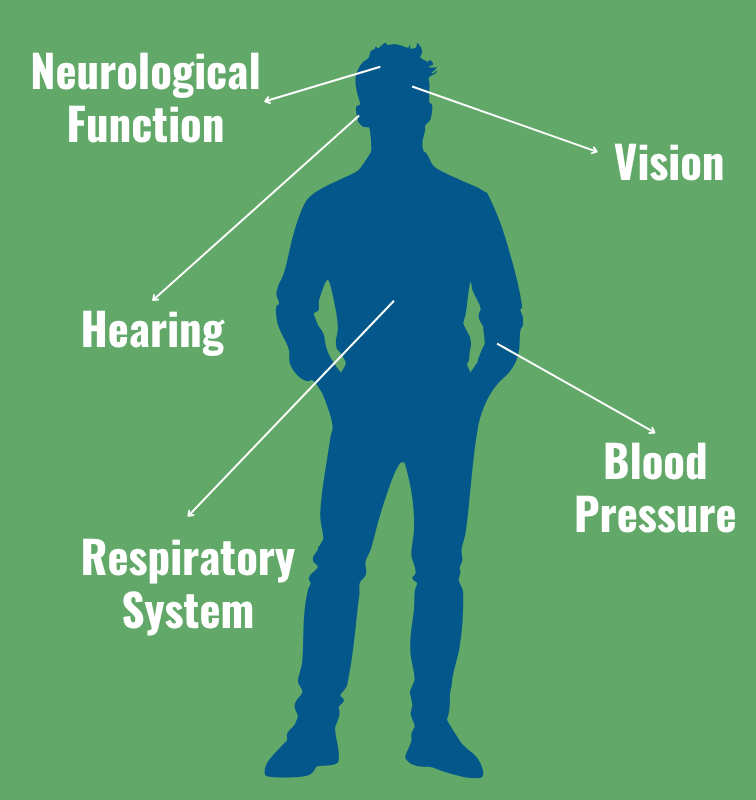
The examiner will conduct a hands-on evaluation that checks your respiratory system, cardiovascular function, musculoskeletal condition, neurological function, and overall physical fitness. The goal is not to evaluate athletic performance. It is to confirm you have the physical ability to safely control a commercial vehicle.
Conditions That May Affect Your Results
Certain conditions do not automatically disqualify you but may require additional documentation or affect the length of your certification.
- Diabetes: Insulin-treated diabetes requires a federal exemption. Non-insulin-treated diabetes is evaluated on a case-by-case basis.
- Sleep apnea: Undiagnosed or untreated sleep apnea can be disqualifying. Drivers who are diagnosed and successfully treating the condition with a CPAP device can qualify.
- Heart disease: A history of cardiac events requires additional documentation and may require clearance from a cardiologist.
- Vision or hearing impairments: Corrective lenses and hearing aids are permitted as long as you meet the minimum standards.
If you have a medical condition you are concerned about, the best step is to speak with your own doctor before the exam. Getting ahead of documentation issues saves time and prevents surprises.
What to Bring to Your DOT Physical
Come prepared with the following:
- A list of any current medications, including dosages
- Glasses or contacts if you use them
- Hearing aids if you use them
- Documentation for any ongoing medical conditions
- Your driver’s license or government-issued ID
The exam typically takes 30 to 60 minutes depending on your health history and the examiner’s process.
How Long Is the Medical Card Valid?
A standard DOT medical certificate is valid for 24 months. Your certification period may be shorter if you have a condition that requires more frequent monitoring, with high blood pressure being the most common example.
You are responsible for keeping your medical card current. If it expires, you lose your CDL driving privileges until you pass a new exam and receive an updated certificate.
The DOT Physical Is One Step in the Process
Passing your DOT physical means you have cleared one of the key requirements on the path to your CDL. To see where it fits in the full picture, including the knowledge test, CLP, ELDT training, and skills test, visit our complete guide:
If you are getting your CDL in North Carolina, Georgia, or South Carolina, the state-specific pages below cover everything from fees to testing procedures in your state:
Frequently Asked Questions
Can I fail the DOT physical and still get my CDL?
Not immediately. If you do not meet the medical standards, you will need to address the issue before you can qualify. This might mean getting blood pressure under control, obtaining documentation for a condition, or applying for a federal exemption. Many drivers who do not pass on the first attempt do qualify after working with their doctor.
Does the DOT physical test for drugs?
No. The urinalysis component screens for health conditions, not controlled substances. Drug and alcohol testing is conducted separately under federal regulations and is managed by your employer.
How much does a DOT physical cost?
Costs vary by provider and location, typically ranging from $75 to $150. Some CDL training programs can point you toward certified examiners in your area.
Do I need to renew my DOT physical?
Yes. Your medical card must stay current for you to hold an active CDL. Standard certification lasts two years, but drivers with certain conditions may need to renew annually or more often.
What if I wear glasses or use a hearing aid?
Both are permitted. The vision and hearing standards apply to your corrected ability, not your unassisted baseline. Just make sure you bring them to the exam.
