

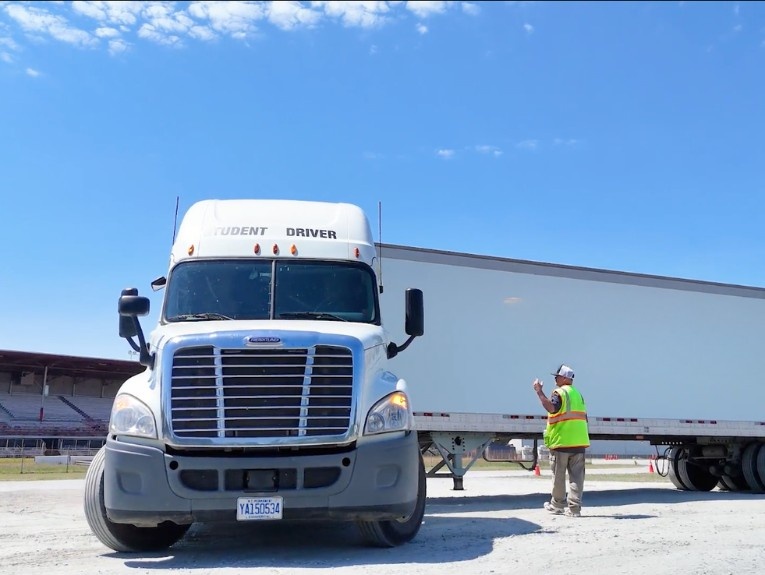
Long before a truck driver merges onto the highway or backs into a busy loading dock, they spend hours as students training in the yard. It’s a wide-open and low-stakes space where mistakes are part of the process of learning how to drive a commercial truck.
Yard training, sometimes called lot training or range training, is one of the stages of CDL school, no matter which campus a student attends. Instructors cover a variety of skills from backing maneuvers to pre-trip inspections to the basic mechanics of operating the truck itself. Here’s what it involves and why it matters so much.
What Happens in the Yard
Yard training is where the fundamentals get built. Before a student ever backs up to a real dock or navigates a live parking lot, they need to be comfortable with the truck itself: how it moves, how it responds, and how much space it needs.
A typical yard curriculum covers a range of skills, including:
- Straight-line backing: keeping the tractor and trailer aligned while backing in a straight path, usually over a set distance, without drifting outside the lane
- 90-degree turns and alley docking: backing a trailer into a tight spot or dock at a sharp angle, a maneuver that demands precise control and constant mirror checks
- Offset backing: backing straight, then shifting the trailer into an adjacent lane, left or right, without overcorrecting
- Parallel parking: backing into a space parallel to the truck, practiced from both the sight side and the more difficult blind side
- Sliding tandems: physically adjusting the position of the trailer’s axles to distribute weight correctly, a skill that matters as much for compliance as it does for handling
- Coupling and uncoupling: safely connecting and disconnecting the tractor from the trailer, including air lines, electrical cords, locking the fifth wheel, and doing a visual and tug test to confirm it’s secure
- Air brake checks: testing the air brake system for proper application, leakage, and low-pressure warnings, a step where a single mistake can mean an automatic failure on test day
- Pre-trip inspection: working through a detailed inspection routine covering close to 90 points on the truck and trailer to meet Federal Motor Carrier Safety Administration requirements
Some of these may sound simple, but they require spatial awareness, memorization, and muscle memory that come only from repetition and practice.
Mic’d Up at TransTech
Check out CDL instructor and veteran Dean Miggins coaching a TransTech student through their straight-line backing during yard training at Wilmington. Site Operations Manager in Greenville, Billy Terry, helps student practice manuevers in the yard.
Learning the Truck Itself, Not Just Maneuvers
Before any backing, students first have to get comfortable with the basic mechanics of operating the semi-truck. This is another piece of yard training that doesn’t always get talked about, but it matters just as much as the maneuvers themselves. It includes things like:
- Finding the friction point of the clutch and learning to double-clutch when shifting
- Managing off-tracking, the way a trailer swings wide on turns, and adjusting the truck’s path to account for it
- Shifting gears smoothly, both up and down, without grinding or stalling
These aren’t skills a student picks up by reading about them. They come from time spent physically operating the truck, in a low-pressure setting, until the movements start to feel natural instead of mechanical.
Pre-Trip Inspection Starts in the Yard Too
Pre-trip inspection often gets treated as a separate topic from backing and maneuvering, but it belongs in the same conversation, because it’s practiced in the exact same place. Long before a student is expected to walk through a full pre-trip routine on test day, they’re out in the yard running through it repeatedly, learning to check the same components in the same order until it becomes second nature.
This matters because pre-trip inspection isn’t just a memorized script. It’s a safety habit. A student who has practiced it dozens of times in the yard, under an instructor’s eye, is far more likely to catch a real problem once they’re doing pre-trip checks on their own, on a real truck, before a real trip. The yard is where that habit gets built.
Why Straight-Line Backing Gets So Much Attention
If there’s one skill instructors tend to emphasize, it’s straight-line backing. It might not look as impressive as a sharp angle turn, but it’s arguably the most valuable skill a new driver can develop.
Here’s why: a crooked tractor creates real problems. It can interfere with other drivers trying to back into adjacent spots, and at some facilities, dock spacing is tight enough that a driver may need to back in a straight line for a few hundred feet before ever reaching the dock. There’s no room for drift or overcorrection. If a driver can hold that line, everything else, angles, spot changes, tight docks, becomes far more manageable.
Low Stakes Now, More Confidence Later
One of the biggest advantages of yard training is the environment itself. There’s no live traffic, no freight on the line, and no dock schedule to worry about. That means students can:
- Practice the same maneuver repeatedly until it feels natural
- Make mistakes without consequences (and learn from them!)
- Get immediate, hands on feedback from an instructor standing right beside the truck
- Build confidence before facing the added pressure of a working dock or public road
This is also where the instructor-student relationship matters most. Talking a student through why their tractor is drifting, why they need to straighten out, and what to watch for isn’t something a manual can teach. It comes from real time coaching, maneuver by maneuver, until the correction becomes second nature.
Skills That Transfer Directly to the Job
The habits built in the yard are the same skills drivers use every day on the job. A driver who has practiced straight-line backing, tight-angle docking, and a full pre-trip routine in a controlled setting is better prepared to:
- Dock at facilities with tight or irregular layouts
- Back safely in shared lots without interfering with other drivers
- Catch mechanical or safety issues before they become a bigger problem on the road
- Stay calm and precise under the added pressure of real freight, real schedules, and real traffic
In other words, yard training isn’t a formality before the road training begins. It is a setting built for learning.
Every Campus, Same Foundation
Whether a student is training in a small-town lot or a major metro campus, the goal of yard training stays the same: build the fundamentals until they’re second nature.
No matter which TransTech campus a student attends, they can expect the same hands-on approach to backing, straight-line control, pre-trip routine, and a dedicated instructor.
Learn more about TransTech’s training programs and find a campus near you.
