

A Complete Guide to Starting Over in Trucking
Changing careers is a big decision. It can feel scary to leave something familiar and start over. But for many people in their 30s and 40s, truck driving turns out to be exactly the fresh start they were looking for.
The pay is solid. The demand for drivers is high. And you can be behind the wheel in as little as four weeks.
In This Article:
- Why Truck Driving Is a Smart Career Move
- Is This the Right Switch for You?
- How Your Current Skills Transfer
- What to Expect When You Switch Careers
- From Decision to First Job
Why Truck Driving Is a Smart Career Move
Truck driving is one of the few careers where you can start earning good money in under two months. You do not need a four-year degree. You do not need years of experience. You just need a CDL and the willingness to show up and do the work.
Here is why so many career changers choose trucking:
- The pay is competitive from day one. First-year drivers typically earn between $40,000 and $60,000. According to the Bureau of Labor Statistics, the median wage for experienced drivers reached $57,440 in 2024.
- Jobs are everywhere. There are more than 80,000 open driver positions right now. The industry is projected to add 237,600 new job openings every year through 2034. Drivers who want work can find it.
- The work is stable. Freight keeps moving no matter what happens in the economy. Groceries, medicine, building materials: it all needs drivers. That kind of demand protects your job even when other industries slow down.
- You can be earning in weeks, not years. CDL training takes three to six weeks. Very few career paths go from “zero experience” to “hired and earning” that fast.
- Your earning potential grows over time. As you build experience, your pay goes up. Drivers can also move into roles like dispatch, driver training, or safety management. Some eventually become owner-operators and run their own business.
- Benefits come with the job. Most carriers offer health insurance, 401(k) plans, paid time off, and sign-on bonuses.
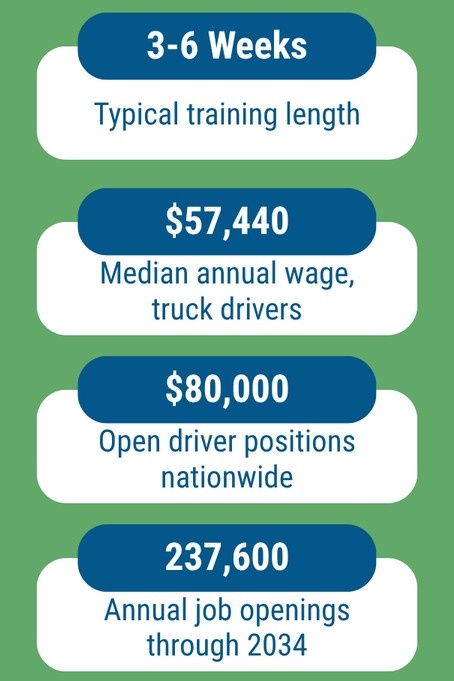
(Sources: American Trucking Associations; Bureau of Labor Statistics)
Is This the Right Switch for You?
Trucking is not for everyone. But for the right person, it is a great fit. You might be a good match if you:
- Like working on your own without someone looking over your shoulder
- Would rather be moving than sitting at a desk all day
- Enjoy seeing clear, concrete results from your work
- Genuinely like driving and do not mind long hours on the road
- Are reliable and take deadlines seriously
- Can handle a schedule that changes from week to week
Who Makes the Switch?
People from all kinds of backgrounds make the move into trucking. Some of the most common include:
- Teachers and school staff
- Construction and trade workers
- Restaurant and hospitality workers
- Office and admin staff
- Military veterans
- Factory and warehouse workers
- Retail employees
- Healthcare support workers
The average CDL driver in the U.S. is 46 years old. There is no upper age limit on earning a CDL. People switch into this career at every stage of life.
How Your Current Skills Transfer
You probably already have skills that trucking employers are looking for. The job is not just about driving. It is about showing up on time, handling problems on your own, communicating with dispatchers and customers, and following safety rules.
Employers in trucking actively value:
- Reliability and time management: if you have ever had to meet deadlines or manage a schedule, that matters here
- Customer service and communication: drivers interact with shippers, receivers, and dispatchers regularly
- Following procedures: safety rules and checklists are a big part of the job, and people who are used to structured work adapt quickly
- Problem-solving: traffic, weather, and last-minute changes happen all the time; drivers who stay calm and figure things out are highly valued
Your past career is not a liability. In many cases, it is an advantage.
What to Expect When You Switch Careers
Making the switch to trucking looks different than starting a traditional new job. Here is what the process actually looks like:
You will need to pass a DOT physical. This is a standard medical exam required for all commercial drivers. It checks your vision, hearing, blood pressure, and general health. Most people pass without any issues.
Your driving record matters. Carriers will look at your record for the past three years. A clean record makes the process easier. DUI charges or multiple accidents can make it harder to get hired.
Training is short but focused. CDL programs run three to six weeks. You will spend time in a classroom, in a training yard, and on the road with an instructor. By the end, you will be prepared to pass your skills test and apply for jobs.
The first year is a learning curve. Even after you are hired, your first year involves building experience and confidence. Most drivers settle into a rhythm quickly.
Which CDL Should You Get?
For most career changers, the decision comes down to Class A or Class B.
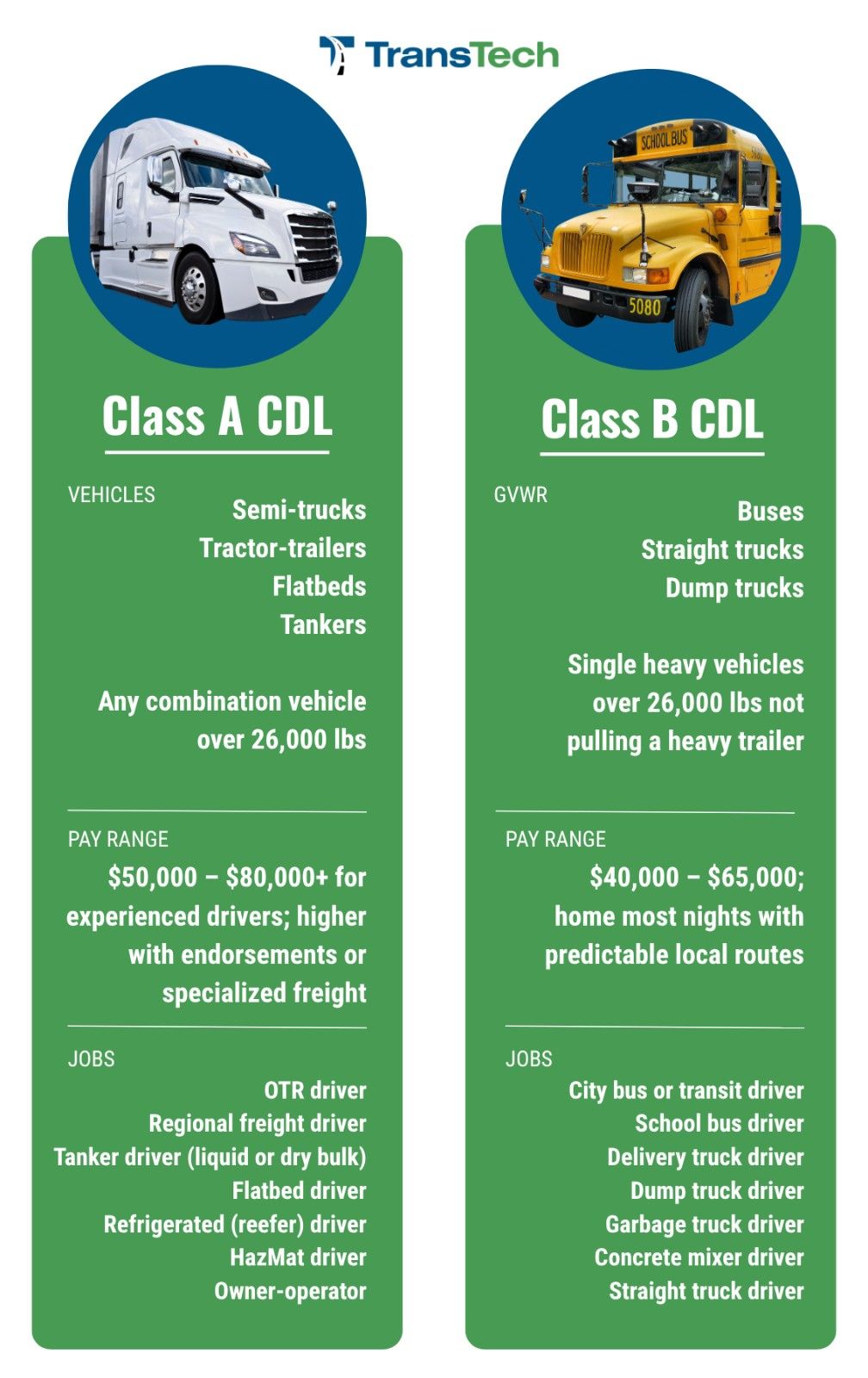
- Class A is the more versatile license. It covers semi-trucks and tractor-trailers, opens the most job options, and generally offers higher pay. Class A drivers can also drive any Class B vehicle.
- Class B is a strong fit if you want local work and to be home every night. It covers vehicles like delivery trucks, school buses, and dump trucks.
Think about how much time away from home you are willing to accept. That answer usually points you toward the right choice.
From Decision to First Job
Here is exactly what the process looks like, step by step:
- Confirm you meet the basic requirements. You must be 21 or older to drive across state lines, or 18 to drive within your state. You will need a valid driver’s license and a clean enough driving record to move forward.
- Pass a DOT physical. A certified medical examiner checks your vision, hearing, and overall health. You will need a valid medical card before you can get your learner’s permit.
- Get your Commercial Learner’s Permit (CLP). You will take written tests on CDL rules and vehicle operation. Federal law requires you to hold your CLP for at least 14 days before taking your skills test.
- Choose a training program. Make sure the program meets federal ELDT standards. Explore funding options before you commit to any payment.
- Complete CDL training. Three to six weeks of classroom time, yard practice, and road driving with an instructor.
- Pass the CDL skills test. The test has three parts: a vehicle inspection, basic vehicle controls, and an on-road driving test. Pass all three and you have your CDL.
- Apply for driving jobs. Put your CDL front and center on your resume. Highlight transferable skills like reliability, customer communication, and time management. Job offers often come before or shortly after graduation.
Most career changers go from decision to hired in six to eight weeks.
Ready to make the switch? Fill out a form to contact admissions and find out which training schedule and funding options work best for you.
