

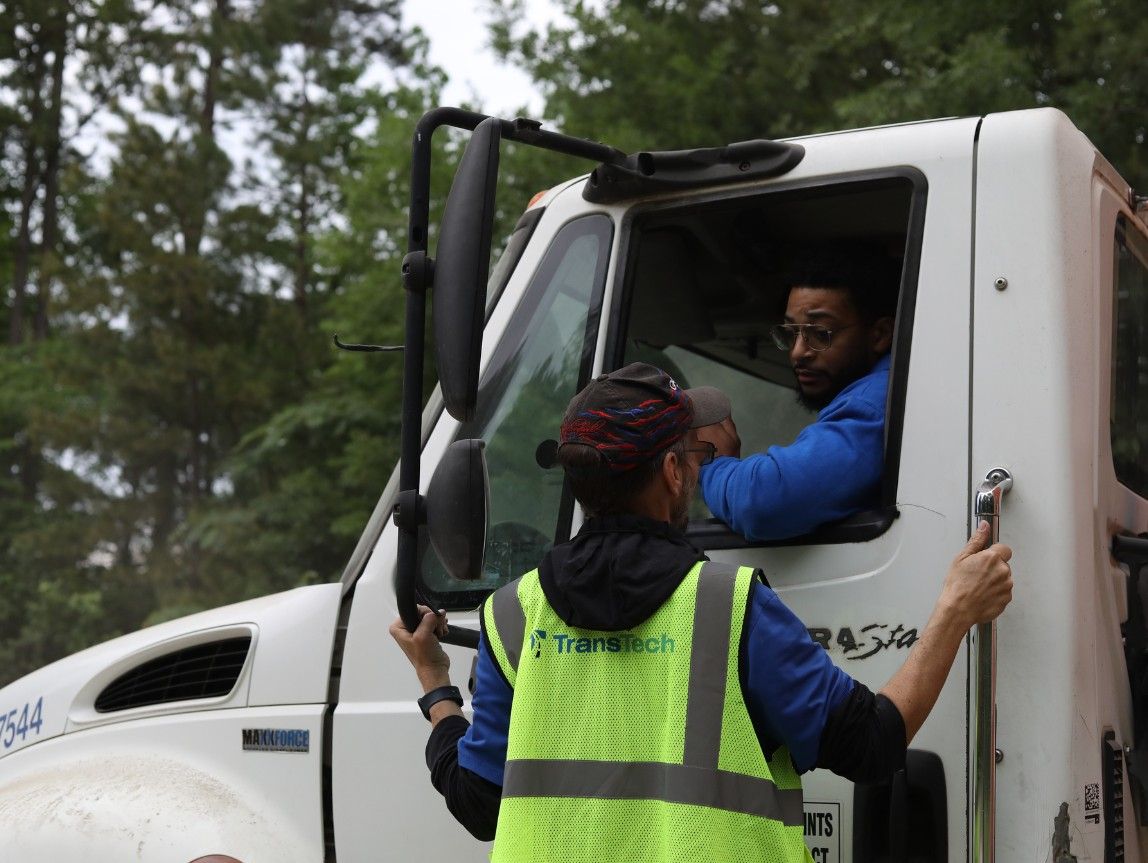
Most people starting CDL truck driving school have never sat in a commercial vehicle. The first week of CDL training is designed for that starting point. Before students get behind the wheel of a Class A truck, they spend five days in the classroom covering the federal regulations, vehicle systems, and safety rules that form the basis of the CDL permit exam.
Week 1 is entirely classroom-based. By Friday, students who complete the coursework are ready to sit for the CDL knowledge tests — the required step before behind-the-wheel training begins in Week 2.
Week 1 at a Glance
- Day 1: Orientation, Hours of Service, Logbooks, and Whistleblower Protections
- Day 2: Safety, Emergency Procedures, and Accident Reporting
- Day 3: Air Brakes, Combinations, and Double and Triple Trailers
- Day 4: Map Reading, Trip Planning, Bill of Lading, Tankers, and HazMat
- Day 5: General Knowledge Review and Permit Test Preparation
How Should Students Prepare for the First Week of CDL Training?
Having the right documents on day one and arriving rested makes a real difference.
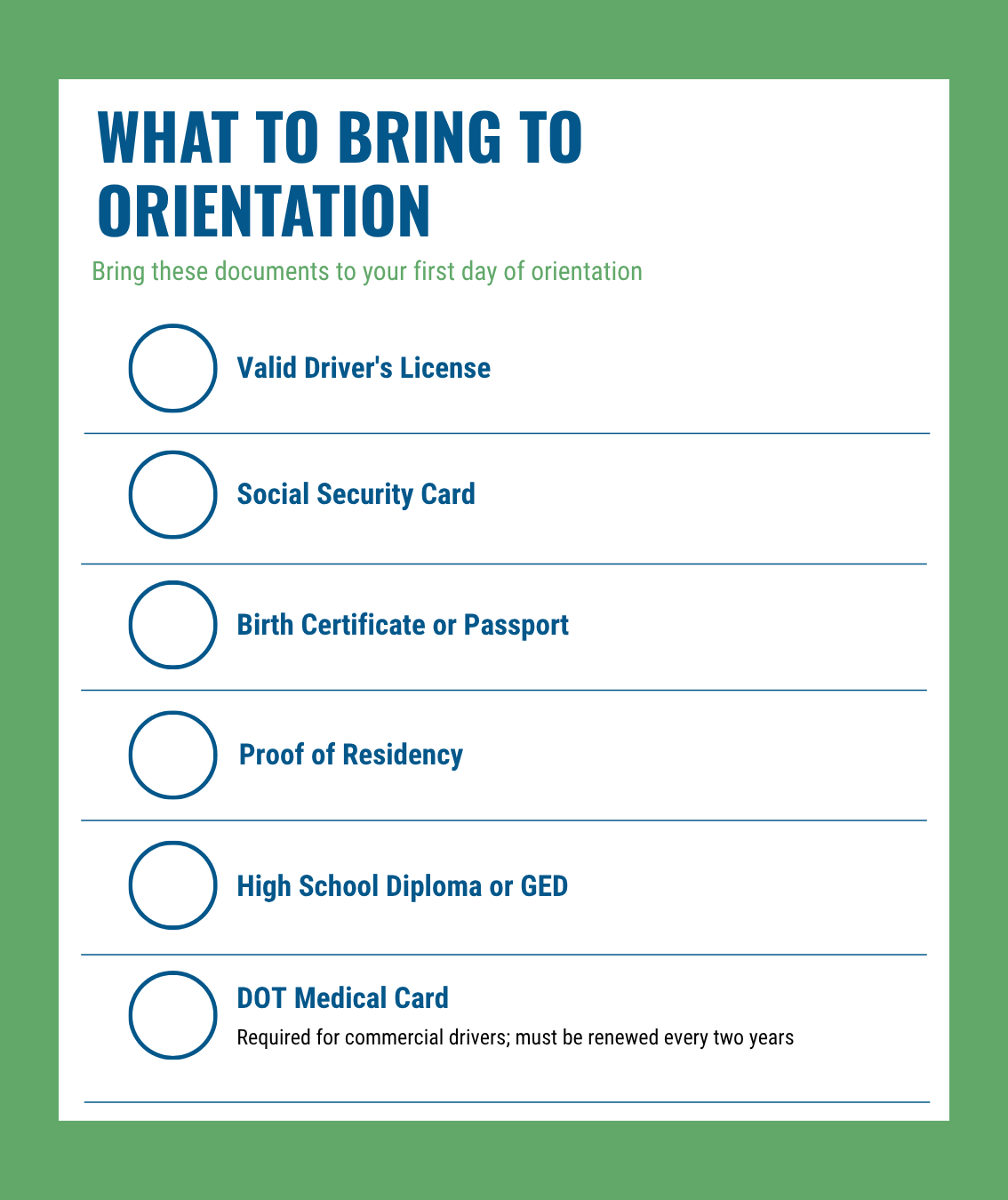
What to Bring to Orientation
One-time documents (bring to orientation):
- Valid driver’s license
- Social Security card
- Birth certificate or passport
- Proof of residency
- High school diploma or GED
- DOT Medical Card (required for commercial drivers; must be renewed every two years)
Daily essentials:
- Notebook and pen
- Water bottle
- Comfortable clothing that allows free movement
- Closed-toe, non-slip boots (required for safety)
Physical and Mental Preparation
CDL training is intensive. Getting enough sleep in the week before classes start helps with information retention. Aiming for seven to nine hours per night is a reasonable target.
Students also need a DOT Medical Card before starting. To prepare for the DOT physical exam, it helps to avoid caffeine for 24 hours beforehand (which can raise blood pressure), eat a light meal, and stay hydrated.
Day-by-Day Breakdown of the First Week
Here is what students can expect each day during the classroom-focused first week.
Day 1: Orientation, Hours of Service, Logbooks, and Whistleblower Reporting
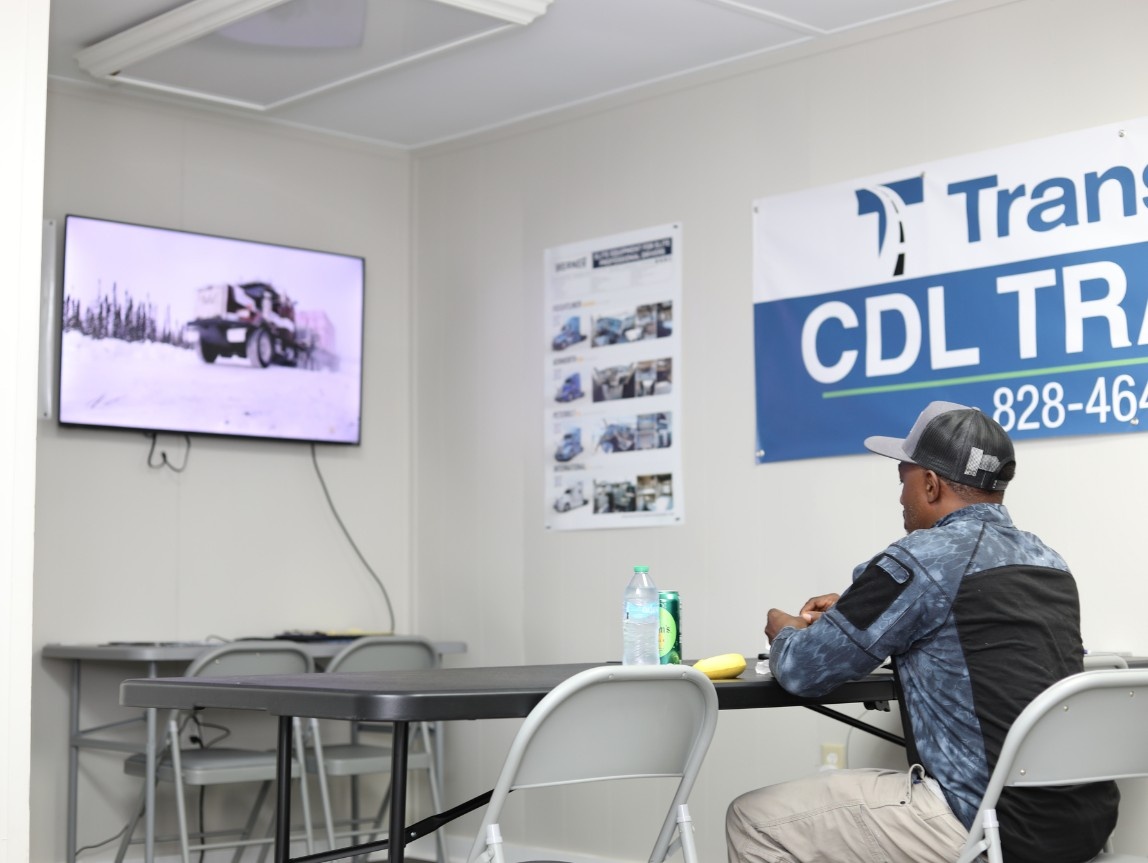
Students arrive at the facility and complete final paperwork. They meet their instructors and classmates, receive training materials, and get a tour of the classroom. The day covers four areas: orientation to the program, hours of service rules, logbook and ELD requirements, and federal whistleblower protections.
Orientation and ELDT Requirements
All CDL training providers must follow Entry-Level Driver Training (ELDT) regulations, which are federal rules set by the Federal Motor Carrier Safety Administration (FMCSA). ELDT requires schools to cover 35 specific topics, score students at 80% or higher on theory tests, and verify competency before graduation. Day 1 orientation explains how the program is structured to meet those requirements and what students are expected to complete.
Hours of Service
Federal law limits how long a driver can operate a truck to prevent fatigue-related accidents. Violations carry serious penalties, and understanding the rules is required for the CDL permit exam.
Key hours of service rules:
- 11-Hour Driving Limit: Drivers may drive a maximum of 11 hours after 10 consecutive hours off duty
- 14-Hour Limit: Drivers cannot drive beyond the 14th consecutive hour after coming on duty
- 30-Minute Break: Required after 8 cumulative hours of driving
- Weekly Limits: No more than 60 hours on duty in 7 days, or 70 hours in 8 days
Logbooks and Electronic Logging Devices
Before electronic logging became mandatory, drivers recorded their hours by hand in paper logbooks. Students learn how logbooks work and how to read them. Modern commercial trucks use Electronic Logging Devices (ELDs), which automatically record driving hours, engine hours, vehicle location, and on-duty and off-duty time. Students learn how to verify ELD data and identify errors that could result in a compliance violation.
Whistleblower Protections
Federal law prohibits motor carriers from retaliating against drivers who report safety violations. Day 1 covers how to file a complaint with the FMCSA and why reporting unsafe conditions is both a legal right and a professional responsibility.
Day 2: Safety, Emergency Procedures, and Accident Reporting
Commercial trucks present safety challenges that most drivers have never encountered. Stopping a loaded 18-wheeler at highway speed requires four to five times the distance of a standard car. Blind spots extend alongside and behind the trailer for significant distances. Day 2 addresses these realities directly.
Defensive Driving
Students learn speed management for different road and weather conditions, safe following distances (a minimum of one second per 10 feet of vehicle length at speeds over 40 mph), strategies for navigating high-traffic areas, and how to anticipate and respond to other drivers’ behavior around large trucks.
Emergency Procedures
Students cover the correct responses to common commercial vehicle emergencies, including brake failure, tire blowouts, jackknifing, and driving in adverse weather conditions such as ice, fog, and high wind.
Accident Reporting
Federal and state laws require specific actions at the scene of a commercial vehicle accident. Students learn what must be reported, to whom, and within what timeframe. They also cover the documentation drivers are required to carry and complete after an incident, including how those records may be reviewed during a DOT inspection.
Day 3: Air Brakes, Combinations, and Double and Triple Trailers
Day 3 covers the mechanical systems that make large commercial vehicles operate differently from standard cars and light trucks. Both topics have their own section on the CDL permit exam.
Air Brake Systems
Unlike the hydraulic brakes on passenger vehicles, commercial trucks use compressed air to activate the braking system. Students learn how air builds pressure in the system, what the low-pressure warning indicators mean, how to perform a pre-trip brake check, and the correct procedure for managing brake fade on long downgrades.
Combination Vehicles and Double and Triple Trailers
Combination vehicles are trucks that pull one or more trailers. Operating them requires understanding how the weight and length of additional trailers affect stopping distance, turning radius, and stability. Students cover the specific endorsements required to pull doubles and triples, the coupling and uncoupling process (connecting and disconnecting trailers from the cab), and the handling differences between standard single-trailer combinations and multi-trailer configurations.
Day 4: Map Reading, Trip Planning, Bill of Lading, Tankers, and HazMat
Day 4 covers the planning and documentation side of commercial driving. These topics address what happens before and during a trip, not just while behind the wheel.
Map Reading and Trip Planning
GPS navigation is useful, but does not always account for truck-specific restrictions. Drivers need to plan routes around bridge height and weight limits, roads that prohibit commercial vehicles, and low-clearance underpasses. Trip planning also includes calculating required fuel stops, mandatory rest breaks under hours-of-service rules, and identifying weigh stations along the route.
Bill of Lading
The bill of lading is the legal document that records what cargo a truck is carrying, where it is going, and who is responsible for it. Students learn how to read and verify a bill of lading, what to do if cargo does not match the documentation, and why accurate record-keeping matters for both regulatory compliance and liability.
Tankers and Hazardous Materials
Tanker vehicles and trucks carrying hazardous materials (HazMat) require additional endorsements on the CDL. Day 4 introduces the handling requirements specific to liquid loads and the federal placarding and documentation requirements for transporting HazMat. Students who plan to pursue tanker or HazMat endorsements will cover these topics in greater depth during endorsement testing.
Day 5: CDL Permit Test Preparation
The final classroom day is dedicated to review and test preparation. By the end of Day 5, students should be ready to sit for the CDL knowledge tests at the state DMV.
Students take practice tests to simulate the format and pacing of the actual CDL knowledge exams. The CDL permit test is administered by the state DMV and is divided by knowledge area: General Knowledge, Air Brakes, and any endorsements the student is pursuing. Passing all required sections earns the student a Commercial Learner’s Permit (CLP), getting them ready for behind-the-wheel training in Week 2.
Common First Week Challenges and How to Handle Them
Challenge 1: Information Overload
The problem: Covering 35 required topics in five days is a heavy load.
What helps:
- Take detailed notes in class
- Review notes each evening for 20 to 30 minutes
- Focus on one topic at a time
- Ask questions when something is unclear; instructors expect it
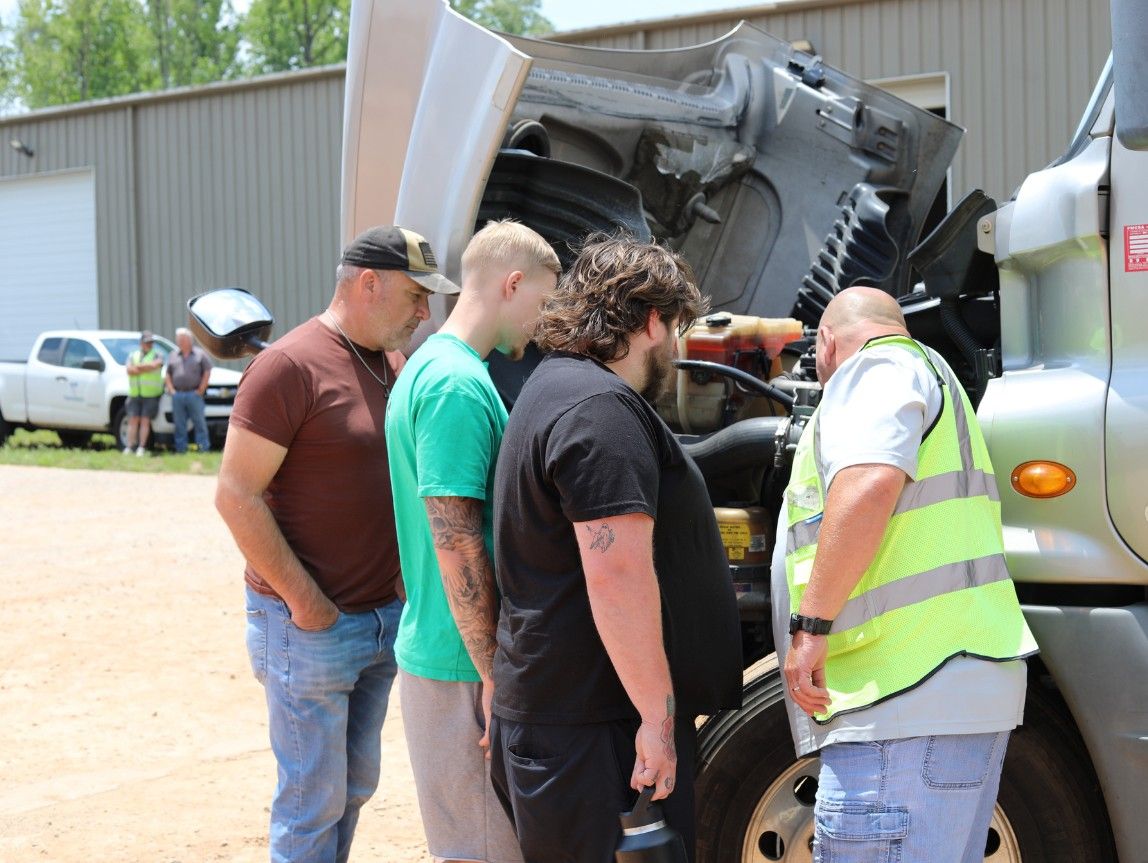
Challenge 2: Learning Pre-Trip Inspection Requirements
The problem: Week 1 covers the rules, terminology, and importance of pre-trip inspections in the classroom. There are dozens of required components with specific names, and students need to know them before practicing the physical inspection in Week 2.
What helps:
- Study the inspection sequence in sections (engine compartment, cab, trailer, rear)
- Make flashcards for component names and what to look for on each
- Read through the inspection checklist daily
- Quiz classmates on terminology to reinforce recall
Challenge 3: Understanding Air Brake Systems
The problem: Air brakes work completely differently than car brakes, and the permit test covers them in depth.
What helps:
- Watch instructor demonstrations more than once
- Draw diagrams to visualize how the system works
- Focus on understanding the reasons behind the design
- Use practice tests to reinforce the concepts
Challenge 4: Test Anxiety
The problem: Nerves on test day can affect performance even for students who know the material.
What helps:
- Take multiple practice tests during the week
- Get at least eight hours of sleep the night before
- Eat a normal meal on test day
- Arrive early
- Students who do not pass on the first attempt can retake individual sections as needed
Conclusion
The first week of CDL training covers the regulations, vehicle systems, and knowledge areas required by federal law before moving to behind-the-wheel training in Week 2.
Coming prepared with the right documents, getting enough sleep, and building consistent study habits from day one give students the best chance of passing the permit exam and moving forward.
FAQs
What is the most challenging part of CDL training for new students?
Most students find learning the pre-trip inspection requirements the most challenging part of the first week. Air brake systems and hours-of-service rules are also commonly difficult at first, but both become more manageable with regular review.
What happens if a student fails the CDL permit test?
Students who do not pass the permit test on the first attempt can retake the sections they did not pass. Students should check with their school and state DMV for specific waiting period requirements before retesting.
Do students need a CDL permit before starting training?
Yes. Under ELDT regulations, students must obtain a commercial learner’s permit (CLP) before they can complete behind-the-wheel training hours. The classroom portion of Week 1 prepares students for the permit exam, which they take before moving to in-cab instruction in Week 2.
What happens in Week 2 of CDL training?
Week 2 moves from the classroom to the cab. Students begin pre-trip inspections, basic vehicle controls, and backing maneuvers, including straight-line, offset, and 90-degree backing. The behind-the-wheel hours required by FMCSA begin once the commercial learner’s permit is in hand.
