

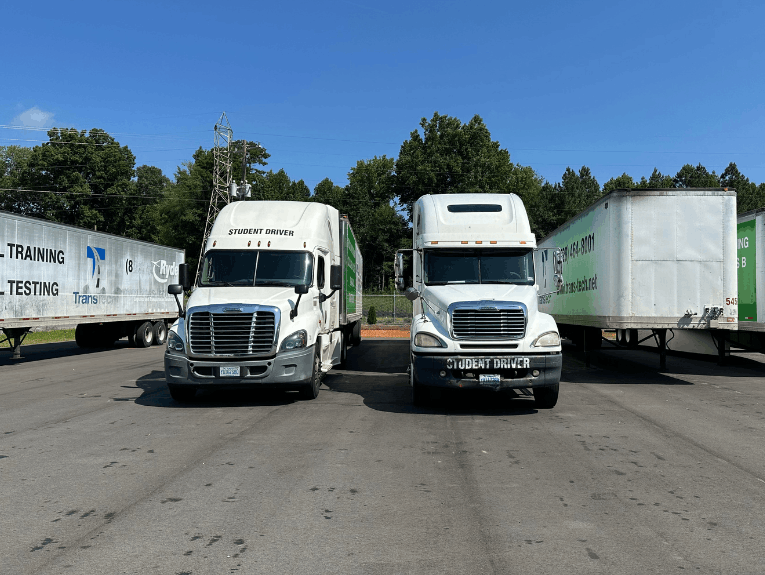
Many truck driving students might be attracted to the idea of paid commercial driver’s license (CDL) training, in which their training costs are covered by their employer. And while “free” CDL training is tempting, there is a binding contract and some pretty big strings attached.
By contrast, attending a CDL school comes with tuition costs ranging between $3,000 and $10,000, but can make the CDL training process easier and more effective, and carries additional financial benefits as well.
What Is Company-Sponsored CDL Training?
In a company-sponsored training program, a trucking carrier funds a driver’s CDL training in exchange for a commitment to work for that company. The company covers tuition and sometimes things like travel, lodging, and meals during the training period. In return, the new driver signs a binding contract before training begins.
Is company-sponsored training free?
These programs are sometimes inaccurately advertised as “free CDL training.” The cost of training is deferred, not removed.
The driver repays the training costs through their labor during the contract period. That often means their wages are reduced. In other words, the employer pays for CDL training up front, then the driver repays the company.
What Is an Independent CDL School?
Independent CDL schools operate separately from trucking companies. Drivers pay tuition, complete the training program, earn a commercial license, and then choose where to apply for work. There are no employment contracts tied to graduation.
These schools come in two main forms: private truck driving schools and community college or technical college CDL programs.
- Private schools often offer smaller class sizes and flexible scheduling, including evening and weekend options.
- Community colleges sometimes offer lower tuition and access to financial aid programs, but often have longer, more rigid course structures and meeting times, fewer resources, and long waiting lists.
Understanding the Contract Terms
The most important thing to understand about company-sponsored programs is what the contract requires. Most contracts commit a new driver to work for the sponsoring company for a set time. Eight to twelve months is the most common range.
If a driver leaves before the contract ends, the remaining prorated training cost becomes due immediately. Depending on the carrier, that balance can range from several thousand dollars to the full program cost.
Here is what a typical contract includes:
| Contract Element | What to Expect |
| Length of commitment | Between 6 months and 2 years |
| Training cost if driver leaves early | Prorated balance due immediately |
| Starting pay structure | Often lower during training and contract period |
| Route and schedule control | Assigned by the carrier, not chosen by the driver |
| Job flexibility during contract | Limited to the sponsoring carrier only |
Before signing, drivers should get clear answers to the following: What is the exact repayment amount if the contract is not completed? What does weekly pay look like during training? Are lodging and meal costs covered, or deducted from pay?
Comparing Earning Potential
According to the BLS, the median annual wage for heavy and tractor-trailer truck drivers was $57,440 in May 2024. Entry-level drivers typically start below that figure while building their safety record and experience.
Starting pay for new drivers generally ranges from $37,000 to $45,000 in the first year, with compensation rising steadily as drivers log more miles and add endorsements.
Drivers completing company-sponsored training often earn less during their contract period because the carrier structures compensation to account for the investment in training. That gap narrows once the contract is fulfilled, but the time spent at lower wages represents a real cost that does not appear in the “free training” pitch.
Independent school graduates can pursue carriers offering the best pay structure from day one. Experienced company drivers typically earn between $52,000 and $68,000 annually, with top earners and specialized drivers reaching $100,000 or more.
Funding Options for Independent CDL School
The main barrier to independent CDL schools is the upfront cost. Paying for CDL training can be scary, but truck driving schools routinely offer students options to reduce or even eliminate out-of-pocket costs.
Workforce Innovation and Opportunity Act (WIOA): Federal grants available to unemployed or underemployed individuals pursuing career training. Eligibility is determined through the local workforce development office.
Veterans Benefits: Eligible veterans can use GI Bill benefits to cover CDL tuition and receive a monthly housing stipend while enrolled full-time.
Dislocated Worker Programs: State-administered funds for workers who have been laid off through no fault of their own. Available through workforce development boards in most states.
Employer Tuition Reimbursement: Many carriers reimburse CDL school costs after hire, typically through monthly payments over 12 months. Drivers retain full earning potential while recovering the training investment.
School Payment Plans: Many independent schools offer payment plans that reduce the upfront burden, sometimes requiring as little as $500 to start.
Before enrolling, consult your CDL school on these options and which you might qualify for.
Weighing the Two Paths: A Side-by-Side Look
| Factor | Company-Sponsored Training | Independent CDL School |
| Upfront cost | Little to none | $3,000–$10,000 |
| Employment contract | 6 months to 2 years required | None |
| Employer choice at graduation | Locked to sponsoring carrier | Any carrier |
| Starting wages | Typically lower during contract | Negotiable with multiple carriers |
| Transmission training | Often automatic-only (E restriction risk) | Could train on both automatic and manual |
| Route and schedule | Assigned by carrier | Negotiated with chosen employer |
| Early exit penalty | Prorated repayment due immediately | No obligation |
How Long Does CDL Training Take?
The exact length depends on how the school structures its schedule and whether the student is enrolled full-time or part-time.
- Full-time programs at private CDL schools typically run three to eight weeks. Community college programs often take longer, because classes may meet fewer days per week.
- Company-sponsored programs vary as well, typically ranging from three to six weeks, but the student is locked into that carrier’s schedule and location with little flexibility.
For someone leaving a job to pursue a CDL, training at an independent school is a short-term investment of time. A student who starts a full-time program in early January could realistically be licensed and applying for driving jobs by February.
What to Look for in a CDL School
Not all CDL schools are the same. Before enrolling, it is worth asking a few basic questions to confirm the school is a good fit.
- What is the student-to-truck ratio? Less time waiting and more time behind the wheel leads to better preparation for the CDL skills test. Smaller class sizes generally mean more hands-on practice per student.
- Does the school offer job placement assistance after graduation? Many independent schools have relationships with carriers and actively help graduates find work. The school helps connect graduates with hiring companies, while the graduate keeps the freedom to choose.
- Is the school accredited and approved by the state? FMCSA-registered schools that meet Entry Level Driver Training (ELDT) requirements are required by federal law for anyone seeking a Class A CDL for the first time. Any legitimate school can confirm its ELDT registration.
What the Job Market Looks Like
The outlook for CDL-licensed drivers remains strong. The BLS projects approximately 237,600 job openings annually through 2034. That volume reflects high turnover and a large wave of retirements, indicating steady, consistent demand for new drivers.
That level of demand gives new drivers, particularly those with unrestricted licenses and independent school credentials, meaningful leverage in choosing a carrier and negotiating pay.
Conclusion
While company-sponsored training offers short-term financial relief, the value of a quality CDL school is clear. While independent CDL schools often require an upfront cost, those costs are often manageable and buy something company-sponsored training does not: freedom.
As a student, it’s important to weigh your options carefully and look at the bigger picture.
Frequently Asked Questions
Is company-sponsored training ever a good choice?
It can be. Drivers who have no access to upfront funding and no other financial aid options may find it the only realistic entry point into the industry. The key is to read the contract carefully before signing, understand the repayment terms, and go in with realistic expectations about starting pay and job flexibility during the contract period.
If I complete a company-sponsored program, am I guaranteed a job with that carrier?
Not always. Some contracts include performance benchmarks or additional requirements before the driving position is confirmed. A student who completes training but does not meet those benchmarks may be released without a job offer but must still repay training costs, depending on the contract language. Reading the offer letter and contract carefully before signing is essential.
What happens if I fail the CDL skills test during a company-sponsored program?
Policies vary by carrier, but most company-sponsored programs allow one or two retests. If a student fails out of the program entirely, the carrier may still require repayment of training costs even though no license was earned.
If a carrier offers tuition reimbursement after hiring, is that the same as company-sponsored training?
No. Tuition reimbursement means the driver attends an independent school, pays for it, is hired by a carrier, and then receives repayment over time, typically in monthly installments over 12 months. The driver graduates with an unrestricted license, chooses the carrier, and is not bound to that employer before training begins.
Do company-sponsored programs and independent schools cover the same curriculum?
The core curriculum is largely the same because both types of programs must meet FMCSA’s Entry Level Driver Training (ELDT) requirements to qualify students for the CDL skills test. The difference is in how that curriculum is delivered.
Is it possible to transfer from a company-sponsored program to an independent school mid-training?
Generally, no. A student who exits mid-program would owe the prorated training cost and would need to fund independent school tuition separately. Starting over at an independent school after leaving a sponsored program is possible, but it comes with real financial consequences.
